Before any warehouse breaks ground, local councils debate it often for months. Rezonings, conditional use permits, tax abatements, environmental reviews, and moratoriums all pass through council chambers before they show up in commercial real estate databases or permit filings. (For a full walkthrough of how these approvals work, see our land entitlement guide.)
Using GatherGov's council meeting dataset, we searched through meetings from over 6,200 municipalities and 1,600 counties for mentions of "industrial" in the first quarter of 2026. We then ran the highest-activity jurisdictions through a structured extraction process to classify each mention by type—warehouse and distribution, manufacturing, brownfield remediation, data center, infrastructure, and more.
The results reveal where industrial real estate activity is concentrated, what kinds of projects are moving through the pipeline, and which councils are friendly (or hostile) to industrial development.
# Where the Conversations Are Happening
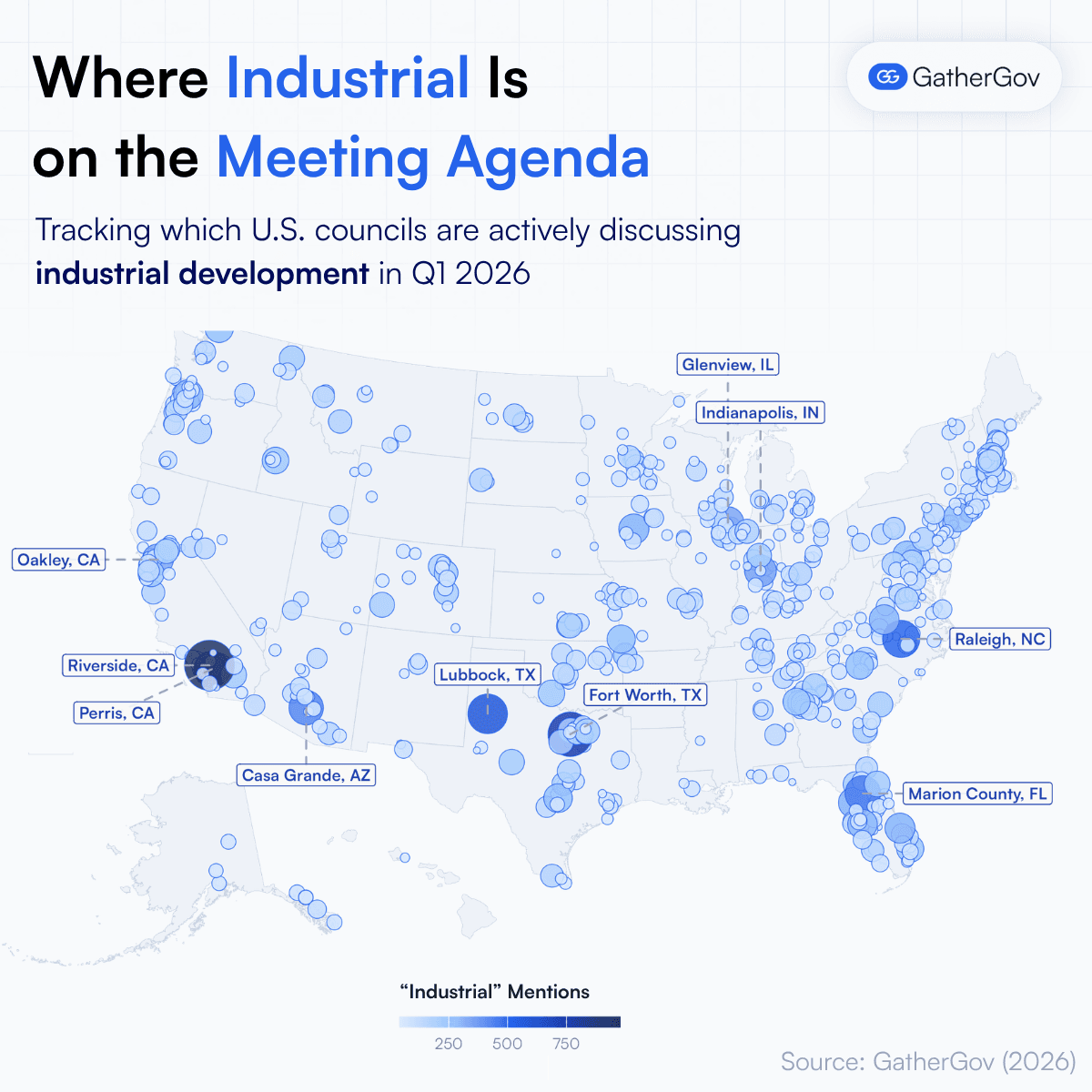
 Number of local governments mentioning industrial activity in council meetings in Q1 2026. Source: GatherGov.
The geographic distribution of industrial discussion tracks closely with industrial employment. California leads with the most individual local governments discussing industrial activity, followed by Texas, Florida, and New York. These are also the states with the largest manufacturing and logistics workforces. California alone accounts for roughly 1.3 million manufacturing jobs; Texas follows with over 900,000.[1] When local governments in these states talk about industrial development, they're responding to real labor market demand.
The pattern holds in the mid-Atlantic and Midwest as well. North Carolina, Indiana, and Illinois all show significant activity, reflecting the ongoing redistribution of warehouse and distribution investment into lower-cost metros with strong freight infrastructure. Many of the same jurisdictions also appear in our analysis of upcoming RFP activity in Q1 2026, where infrastructure and construction procurements often accompany industrial expansion.
Looking deeper into the top 10 cities and counties with the most mentions, the picture becomes more granular, and more useful for developers, investors, and contractors tracking the industrial real estate pipeline.
| Rank | Jurisdiction | Mentions |
|---|---|---|
| 1 | Riverside, CA | 979 |
| 2 | Fort Worth, TX | 749 |
| 3 | Lubbock, TX | 583 |
| 4 | Raleigh, NC | 502 |
| 5 | Perris, CA | 472 |
| 6 | Marion County, FL | 453 |
| 7 | Casa Grande, AZ | 425 |
| 8 | Indianapolis, IN | 354 |
| 9 | Glenview, IL | 347 |
| 10 | Oakley, CA | 336 |
# What the Top 10 Are Actually Building
# Riverside, CA — 979 Mentions
Warehouse Distribution | Adaptive Reuse
"The case involves a zoning code map and text amendment, tentative parcel map, design review, development agreement, and environmental impact report to facilitate the development of two warehouse buildings." — Riverside Planning Commission Meeting
 Most of industrial discussion in Riverside is centered around the Massachussetts Point Project
Riverside dominates the list with nearly 1,000 industrial mentions in Q1 2026 with the majority centering on one project. The Massachusetts Point Project, proposed by Staley Point, involves demolishing outdated industrial buildings on a 14.42-acre site and constructing two new warehouse buildings totaling roughly 100,000 square feet. The project requires changing the Innovation District Overlay Zone from an employment and housing emphasis to an industrial emphasis for modern logistics facility space. For a deeper look at Riverside's full development pipeline, see Riverside's municipality page.
The project has appeared before the Planning Commission repeatedly across multiple meetings this quarter, progressing through environmental impact review, design review, and a development agreement. The site is undergoing soil remediation, which will result in a deed restriction preventing sensitive uses in the future, effectively locking in the industrial designation permanently.
# Fort Worth, TX — 749 Mentions
Brownfield Remediation | General Industrial | Data Center
"We can't breathe. Due to existing pollution, noise, and traffic, which affects the community's health, well-being, and safety." — Jerome Johnson, President, Highland Hills Neighborhood Association, Fort Worth City Council Meeting
 The proposed data center at Veal Ranch offers significant fiscal benefits, yet progress has stalled in recent hearings due to community opposition.
Fort Worth's industrial discussions are among the most diverse and contentious in the top 10. The city is simultaneously processing a $1.1 billion data center proposal at Veal Ranch, brownfield remediation for a 57.5-acre former industrial site on South Freeway, an $80 million industrial rezoning near Lake Arlington, and zoning amendments to regulate medical marijuana cultivation in industrial districts. You can track all of these projects and more on Fort Worth's development pipeline page.
The brownfield project at 55921-5933 South Freeway illustrates how industrial real estate redevelopment works in practice. The site, contaminated with arsenic, lead, and manganese from historical dumping, requires a Municipal Setting Designation to restrict groundwater use and enable warehouse construction. The developer has offered to donate 14 acres as a buffer zone between the industrial development and the adjacent residential community, a concession driven by intense community opposition.
The proposed data center at Veal Ranch represents a $1.1 billion capital investment across two phases, with the city offering a 10-year tax abatement for 50% of business personal property taxes. The project is expected to generate $68 million in taxes over the decade, with $18.2 million abated, a net $49.8 million gain for the city.
However, Forth Worth is also scaling back on some of its industrial activities. The Zoning Commission advanced a council-initiated rezoning of approximately 3,300 acres near the Trinity River from various classifications—including light and heavy industrial—to floodplain, explicitly to protect the river from further industrial development.
# Lubbock, TX — 583 Mentions
Manufacturing | Industrial Park | Incentives
"I just wanna say that government does not need to give money to big businesses. It's especially unfair that smaller local businesses don't benefit from this type of government favoritism."Lubbock City Council Meeting
 Lubbock City Council wants to attract manufacturing facilities through investment incentives
Lubbock wants to attract manufacturing facility through investment incentives. In Q1 2026, the council approved three separate incentive deals: a $500,000 capital investment incentive for an unnamed manufacturer committing to 120 new jobs, a $250,000 incentive for Hidden Eight LLC and Suncrest Holdings expanding with a $15.4 million manufacturing facility at a new location, and a $50,000 incentive for Industrial Molding Company LLC to add a helmet and sporting goods production line. See Lubbock's development pipeline for the latest on these and other projects moving through council.
Notably, one councilmember consistently voted against all three incentives, arguing that government funding for corporations undermines free market principles.
On the zoning side, Lubbock approved a contentious rezoning of property containing oil wells from residential to industrial park by a narrow 4-3 vote, reflecting the tension between generating tax revenue from industrial property and managing impacts on adjacent residential communities. (For context on how commercial and industrial zoning classifications differ, see our commercial zoning guide.)
# Raleigh, NC — 502 Mentions
General Industrial | Brownfield Remediation | Adaptive Reuse
"There is likely soil contamination on properties with long histories, potentially from old industrial sites, dry cleaners, or service stations." — Raleigh City Council Meeting
Raleigh's industrial mentions follow a trend we are seeing of adaptive reuse reshaping older industrial property in fast-growing metros. The city approved a rezoning of 7.8 acres from heavy industrial to industrial mixed-use for a pickleball facility. Multiple rezonings from industrial to residential also appeared this quarter, reflecting demand pressure in a market where housing needs increasingly compete for (well suited) industrial properties. For the full picture of what's moving through Raleigh's pipeline, see Raleigh's development pipeline page.
The council also discussed brownfield exclusions under North Carolina general statutes, noting that a $100 million development on a brownfield site could see its taxable value reduced by 90% in the first year of exclusion. In fiscal year 2025, Raleigh had $514 million in value attributed to brownfield exclusions, resulting in a $1.8 million loss in city taxes. As a result, the city is reexamining its exclusion policy.
# Perris, CA — 472 Mentions
Warehouse Distribution | Moratorium
"The city, with the partnership of the developer, has updated industrial development guidelines, requiring Conditional Use Permits for industrial projects over 50,000 square feet." — Kenneth Fung, Director of Development Services, City of Perris Council Meeting
 Harvest Landing is a upcoming 358 acre Mixed Use Development with Retail, Residentail—and Warehouse—component. Source: Howard Industrial Partners
For anyone looking at warehouse real estate market in the Inland Empire, Perris should be in your top 10. The city simultaneously has one of the most aggressive warehouse construction pipelines in Southern California and has enacted a moratorium to slow it down. Track the full scope of activity on Perris's development pipeline page.
In December 2025, the council unanimously approved a 45-day moratorium on new warehouse and distribution uses. In January 2026, they extended it for an additional 10 months through to December 9, 2026. The moratorium requires a four-fifths vote and exempts projects with vested rights.
Despite the moratorium, the Harvest Landing project continued advancing. This 358-acre project includes a 391,725-square-foot "parcel hub" for FedEx, commercial retail, and residential components. The project drew fierce community opposition, with one councilwoman noting the parcel hub generates four times the truck traffic of a regular warehouse. The council ultimately approved the project with conditions including a perpetual covenant prohibiting warehouses and a $15 million penalty if commercial components are not operational when FedEx receives its building permit.
Council meetings indicate a staggering pipeline of other active warehouse construction projects: a 764,000-square-foot Pro Logistics building, a 1-million-square-foot IDI PLC North building, three buildings totaling 3.3 million square feet at IDI PLC South, and multiple other grading-stage industrial buildings ranging from 94,000 to 443,000 square feet.
# Marion County, FL — 453 Mentions
Industrial Park | Incentives | General Industrial
"A homeowner should not be penalized by having to build a wall when an industrial park is built next to their single-family home." — County Commissioner, Marion County Board Meeting
 Marion County is a hub for private airports and aviation hobbyists, a feature that reflects in the items discussed in its council
Marion County is trying to say yes to industrial growth but its residents are making that complicated. On one hand, the city is pursuing policies that make the county attractive to industrial uses. The Board of County Commissioners recently discussed whether its 50-foot height limits in AGAMA Social Industrial zones are tall enough to accommodate airport-adjacent development—a signal that indicates entitlement flexibility for industrial property near airport zones.
But the projects already in the pipeline are generating friction. The Cypress Road Industrial Park, in the county's southeast, came before the board seeking a buffer waiver—an attempt to reduce the required setback between the industrial park and neighboring properties. That request landed in the middle of a broader debate over who should pay for buffers when industrial development pushes up against single-family homes. Commissioners sided firmly with residents, arguing that the more intense use—the industrial park—should bear the cost of screening, not the homeowner who was there first.
# Casa Grande, AZ — 425 Mentions
Manufacturing | Infrastructure | Incentives
"KPPC chose Casa Grande for a reason. We have an area for it. If they're trying to do it where we have said it should happen and then we go and take that back, it's a black eye on the city." — Chairman Benedict, Casa Grande Planning and Zoning Commission
 Casa Grande City Council's activity in Q1 2026 was dominated by a CUP appeal for the KPCC project, a 26-acre chemical manufacturing plant for semiconductor manufacturing. Source: WSA Architects/City of Casa Grande
Casa Grande is emerging as a semiconductor supply chain hub, and its council meetings reflect the infrastructure and regulatory work required to support that transition. The most significant industrial action this quarter was an appeal hearing for a conditional use permit for KPPC, a chemical manufacturer proposing a 26-acre semiconductor-grade chemical purification campus. Phase one will employ 58-61 workers; future phases will expand production of chemicals supplied to TSMC and Intel fabs in Phoenix and Chandler. For the full rundown of what's moving through the city, see Casa Grande's development pipeline.
The Planning and Zoning Commission initially denied the permit on a split vote—not because they opposed the project, but because of truck traffic concerns on roads the city cannot regulate (Pinal Avenue is state-controlled). The appeal to city council revealed the tension between economic development ambition and infrastructure readiness.
Separately, Casa Grande developed and adopted a comprehensive effluent allocation strategy that reserves 40% of reclaimed water for industrial and commercial uses, a forward-looking policy designed to attract water-intensive manufacturers to the region. The city also approved a 23-acre rezoning from commercial to general industrial to meet what staff described as "significant demand for general industrial land," and is planning rail infrastructure expansion on its west side to support semiconductor manufacturing and logistics growth.
# Indianapolis, IN — 354 Mentions
Data Center | General Industrial
"The Decatur Township Civic Committee voted 95 to 2 to oppose the petition." — Pat Andrews, Chair, Land Use Committee, Indianapolis Hearing
 Indianapolis's Q1 industrial discussion was focused on the upcoming Sabey Data Center Development
Indianapolis is ground zero for the national debate over data center construction. Sabey, a data center company, is seeking a use variance for a 130-acre site off Kentucky Avenue to build a data center on land originally zoned for a technology park. The proposal includes commitments to pay for a new substation, prohibit cryptocurrency mining, cap noise at 65 decibels, and contribute $5.4 million for road improvements. You can follow this and other active projects on Indianapolis's development pipeline page.
Community opposition is organized and vocal. The Decatur Township Civic Committee argues the data center would create only 100 jobs compared to the thousands originally envisioned for the technology park, and that buildings exceeding 200,000 square feet and 35 feet in height violate the comprehensive plan.
Beyond the Sabey proposal, the city council hosted a broader policy discussion on data center environmental impacts, with community members and environmental groups calling for moratoriums, independent impact studies, and requirements that developers cover full energy and infrastructure costs. One council member explicitly favored an immediate total moratorium on data centers.
The council also approved flex industrial property buildings designed for small contractors, a growing niche in the industrial market serving HVAC, plumbing, and trades businesses that need 600-2,500-square-foot spaces.
# Glenview, IL — 347 Mentions
Manufacturing | Industrial Park
"All requirements, conditions, and commitments set forth in the original plat approved on October 6, 2022, for the final plat of the logistics campus, will remain in full effect." — Glenview Plan Commission
 Upcoming Dermody Logistics Campus is Glenview
Glenview's industrial activity centers on the Dermody Logistics Campus, the redevelopment of the former Allstate corporate offices into an industrial park. This quarter, the Plan Commission approved a resubdivision consolidating parcels to provide more flexibility for the campus, which now includes Hugh Frady, a medical equipment manufacturing and packaging company. The commission confirmed that any future major development changes would require additional review—maintaining village oversight while enabling incremental industrial densification. See Glenview's development pipeline for more detail on these projects.
Separately, the village processed a Navy remediation project that drew public concern about truck routing through residential areas, highlighting the brownfield challenges that accompany older industrial sites even in affluent suburban markets.
# Oakley, CA — 336 Mentions
Industrial Park | Data Center Debate
"The applicant requested that 'data center' be removed from the planned unit development during the March 10th city council meeting, which was a significant concession." — Oakley City Council Meeting
 The Bridgehead Industrial Plan Unit was the cause of significant debate in Oakley City Council
Oakley's mentions are driven almost entirely by the Bridgehead Industrial Plan Unit Development, an industrial park project that became a flashpoint for data center opposition. The original PUD included "data center" as a permitted use, but community pressure forced the applicant to remove it.
Even after the removal, the project drew public opposition from residents citing air quality concerns and health impacts from industrial emissions. The council approved the PUD with the data center exclusion, while separately receiving a report on the Green Empowerment Zone—a regional initiative focused on clean energy, industrial power rates, and the infrastructure needs of logistics and warehouse operations.
# Why This Matters for Industrial Real Estate
Most industrial real estate data tracks completed transactions from lease signings, permit issuances, construction starts. That information is valuable but late. By the time a warehouse appears in a construction database, the zoning was approved months or years earlier.
Council meeting discussions happen upstream. A rezoning vote or even a moratorium debate reveals where industrial demand is forming, and where local governments are actively courting or discouraging industrial development.
For developers scouting sites, the data reveals which jurisdictions are friendly to warehouse construction and which are hostile. Perris, for example, has an enormous active pipeline but also a moratorium meaning the window for new entrants is closing. Casa Grande is actively expanding industrial land supply and building water infrastructure for manufacturers. Fort Worth is simultaneously approving billion-dollar data centers and rezoning thousands of acres away from industrial use.
GatherGov tracks these discussions across more than 7,800 jurisdictions in real time, surfacing upcoming industrial development signals and local market intelligence before they become formal postings. Whether you're tracking warehouse real estate pipeline, data center construction approvals, or manufacturing facility incentive deals, the earliest signals live in council chambers.
# FAQ
# What are the best sources for upcoming industrial real estate development data?
Council meeting transcripts are among the earliest public signals for industrial development projects. Rezonings, conditional use permits, and development agreements are discussed in council meetings months before formal permits or construction starts appear in commercial real estate databases.
# Which states have the most industrial development activity in 2026?
California, Texas, Florida, and New York lead in the number of local governments discussing industrial activity. These states also have the largest manufacturing and logistics workforces, reflecting genuine labor market demand for industrial property.
# What is driving warehouse construction in the Inland Empire?
The Inland Empire continues to see massive warehouse construction pipelines driven by e-commerce logistics demand and last-mile delivery infrastructure. However, communities like Perris are enacting moratoriums and new conditional use permit requirements for projects over 50,000 square feet, signaling growing regulatory friction.
# Are data centers facing opposition at the local level?
Yes. Cities including Indianapolis and Oakley have seen organized community opposition to data center construction, with concerns about energy consumption, water usage, limited job creation, and environmental impacts. Some jurisdictions have discussed moratoriums, while others require developers to cover full infrastructure costs.
# How can real estate developers track industrial zoning changes before they happen?
Monitoring council meeting agendas and transcripts provides the earliest visibility into upcoming rezonings, moratoriums, and development agreements. Tools like GatherGov automate this process across thousands of jurisdictions, providing construction data and market signals before they appear in traditional databases.
# Footnotes
-
Bureau of Labor Statistics, Current Employment Statistics, State and Metro Area, December 2025. ↩